Sunday, June 25, 2017

Learn Hacking using Backtrack 5

About this course

Social Engineering, Metasploit, Nmap and Much More
By the numbers
  1. Lectures: 27
  2. Video: 2.5 hours
  3. Skill level: All Levels
  4. 248 students
  5. Languages: English

Features

  1. Lifetime access
  2. Available on iOS and Android
  3. Certificate of Completion

Description


Welcome to "Learn Hacking using Backtrack 5". This is a course dedicated to learning the backtrack 5 Linux OS along with many of the tools it comes with. Please note that everything on this course is purely educational and we are not responsible for your actions.
  • Backtrack Basics: New to Backtrack? What to learn how to get started and learn the basics of hacking? Then this is where you want to start! These videos include how to install backtrack, updating tools, and the protocol to take when taking over a system.
  • Backtrack Intermediate: For those who want more than the basics. Includes web-based exploitation and the use of backdoors.
  • Backtrack wireless: That magical piece of technology that gives you access over the air-waves and its vulnerabilities.:
  • Metasploit is an amazing framework for exploits and updates almost everyday. These videos cover some of the things Metasploit can do, and how to use it.
  • Tutorials on learning to code your own exploits and other useful things for penetration testing.
What are the requirements?
  • Internet
  • A computer which you can format and experiment with
What am I going to get from this course?
  • Learn Backtrack
  • Learn Nmap
  • Learn Metasploit
What is the target audience?
  • Hackers
  • Web Developers

Friday, June 16, 2017

[Share] Tools Boot Traffic SSH

Tools Boot Traffic SSH


Chào các bạn SEOer, như các bạn đã biết sau khi xây dựng backlink cho website, việc tiếp theo là chúng ta phải submit backlink đó lên Google để các công cụ tìm kiếm index backlink đó càng nhanh càng tốt. Đồng thời chúng ta cũng phải chia sẻ backlink đó lên mạng xã hội để tăng lưu lượng truy cập đổ về website mà chúng ta cần SEO. Ngoài ra chúng ta có thể sử dụng một số phần mềm boot traffic để tự động click vào backlink đó. 

Tool Boot Traffic miễn phí


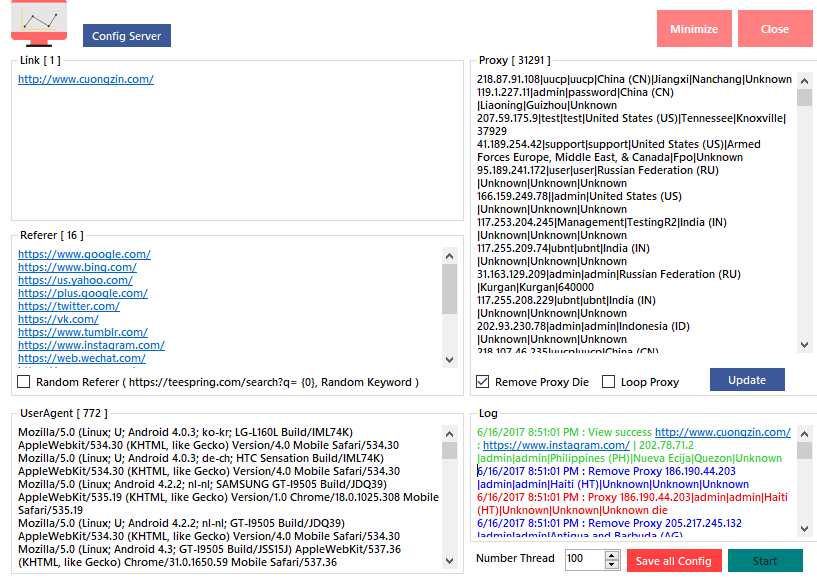
Hiện nay trên thị trường có khá nhiều Tool Boot Traffic, chẳng hạn như iView Premium hoặc iClick tuy nhiên các phần mềm này đều có phí. Hôm nay mình sẽ chia sẻ với các bạn Tool Traffic do mình tự code trên nền tảng .Net đây là 1 Tool Boot Traffic bằng SSH khá hiệu quả. Đặc biệt tool này có thể tự động click vào tọa độ trên website mà mình đã cài đặt, có thể fake Link Referral, các bạn xem báo cáo của Google Analytics bên dưới sẽ rõ.


boot-traffic-google-analytics

- Để tải phần mềm các bạn vui lòng để lại email mình sẽ gửi phần mềm vào hộp thư mail của các bạn ngay sau đó. Chi tiết liện hệ Facebook : Cường Nguyễn.

Friday, June 9, 2017

Public SMS Message Repository

Public SMS Message Repository

Introduction

This project enables an individual use a mobile phone to store a short message "in the cloud", that can be picked up by others using their mobile phone.
This project will demonstrate how to:
  • use the Twilio TwiML API to respond to SMS messages;
  • use XML as a data store;
  • have some political fun along the way.

Before we get started, see the application in action. Using your mobile phone, SMS (text) bush to +1 530 PROJECT (as in Code Project, or +15307765328).
Note: The demo does not allow addition/change/deletion of messages.

Background

My softball team had a problem. If a game was cancelled or rescheduled due to rain (or hail), it was difficult to relay the message to all the players quickly. They would drive to the ball park, only to learn about the cancellation.
This project, written in 2012, and rewritten for this article, is a solution. It works like this:
  1. The team captain sets a message by sending a message to the application:
    set rainout bingo July 5 @ 10:00 Today's games are cancelled.
  2. The application responds:
    rainout set: July 5 @ 10:00 Today's games are cancelled.
  3. Players can check the status by sending a machine to the application:
    rainout
  4. The application responds:
    July 5 @ 10:00 Today's games are cancelled.

How it Works

Twilio is a telephony gateway. It bridges data and voice between the internet, POTS, and 3GPP networks. By setting up an account with Twilio, calls and messages be be directed to and from an assigned number.
This project uses a simple API, called TwiML. It's use is very simple:
  1. A phone number is associated with a web application by specifying the URI of the application.
  2. When the number receives a message, an HTTP POST is made to the specified URI as application/x-www-form-urlencoded, containing data and metadata.
  3. The application responds to the request with an XML document (TwiML), containing instructions on how to respond.
  4. The response is relayed back to the requestor.

Inside the Code

https://www.codeproject.com/KB/Articles/996504/Sms.png
In this example I have used IIS/ASP.NET to act as the HTTP server and scripting interface. Incoming requests are handled by overriding the Render method of the Default Page class. If a form is POSTed with a Bodyparameter, the Controller is invoked.

Controller

Examples of valid request messages are:
  • bush
  • set greeting bingo Thanks for stopping by!
  • greeting
  • delete greeting bingo
ParseTwilioRequest uses a regular expression to split the message into its components.
// Parse the twilio request.
string command = string.Empty, message = null, password = null, key = null;
var matches = Regex.Match(request, "^(?<command>[^ ]+) (?<key>[^ ]+) (?<password>[^ ]+)(?: (?<message>.*))?$|^(?<command>[^ ]+)(?: (?<values>.*))?$");
The possible message components are:
command
A verb/instruction. This is the only required component. Valid commands are any stored key, hello, ping, set, delete, and bush.
password
If performing a set or delete command, a password is required. The password is specified by Repository.Password.
key
If performing a set or delete command, the key of a key/message pair. The key must match a pattern, specified by Repository.KeyPattern.
message
If performing a set or delete command, the message of a key/message pair.
If no components are present, or the command is invalid, a default message is returned.

Repository

The application uses and XML file as a data repository, abstracted by the Repository class. It subclasses XDocument, and provides properties and methods to manipulate its data.
<?xml version="1.0" encoding="utf-8" standalone="yes"?>
<repository password="bingo" pattern="[a-zA-Z0-9]{3,10}">
  <default>Reply with [hello|bush|{0}]. +1530PROJECT brought to you by Red Cell Innovation Inc.</default>
  <message key="foo">bar</message>
  <message key="rainout">July 5 @ 1000 Today's games are cancelled.</message>
</repository>

Bushisms

Just for some fun, a bush request invokes Bushisms.GetRandom() for a random Dubya quote.

Deployment

  1. Copy the provided files to your web server.
  2. Open a Twilio account (you'll receive some free credit).
  3. Order a telephone number.
  4. In the telephone number configuration, assign the URI of your application the to the SMS callback.
  5. Test, and use Twilio's alerts panel to debug.
Once your credit expires, this project will cost:
  • about USD 1.00 per month for a telephone number;
  • about USD 0.0075 (¾¢) per message sent or received.

Security Considerations

For my use, security was not a major concern. Keep in mind:
  • The password, used to set and delete messages is stored in plain text in the repository.xml file, so are the messages.
  • To secure the application, it should be configured on a server that uses SSL/TLS (HTTPS) to encrypt the transport of messages between Twilio and the web server.
  • By design, messages can be retrieved from the store using only a keyword.

Contribute

How could you use this application? What other use cases can you imagine? Add your response below.

Conclusion

This project demonstrates how to build a simple SMS application without the use any external libraries or dependencies.
I am not affiliated with Twilio. This article is not an endorsement for Twilio. Twilio is one telephony gateway, and there are many others. Each may offer different services, at different costs.
Note: Offering a working demo for this article has real costs. The cost of this demonstration is sponsored by Red Cell Innovation Inc. If you require development of a telephony or mobile application, please consider us.

History

  • May 31, 2015 – First publication

Download Source Code


Google Translate Desktop Application in C#.NET

Google Translate Desktop Application in C#.NET


Introduction

This tip demonstrates how to implement Google translate in your C# application without purchasing its API.
Points of Interest are:
  • We are using Google translate service so an internet connection is required.
  • We are sending HTTP requests like a browser does.
  • We are parsing the output and displaying result.
Features of Application are:
  • Grabs input string from clipboard as soon as application starts or its window is actived.
  • Language change option is available in context menu on each textbox.
  • Translate while typing.
  • Shows single or all meanings of given word.
  • Shows meaning with corresponding sentence surrounded with [ ].

Snapshots

Using the Code

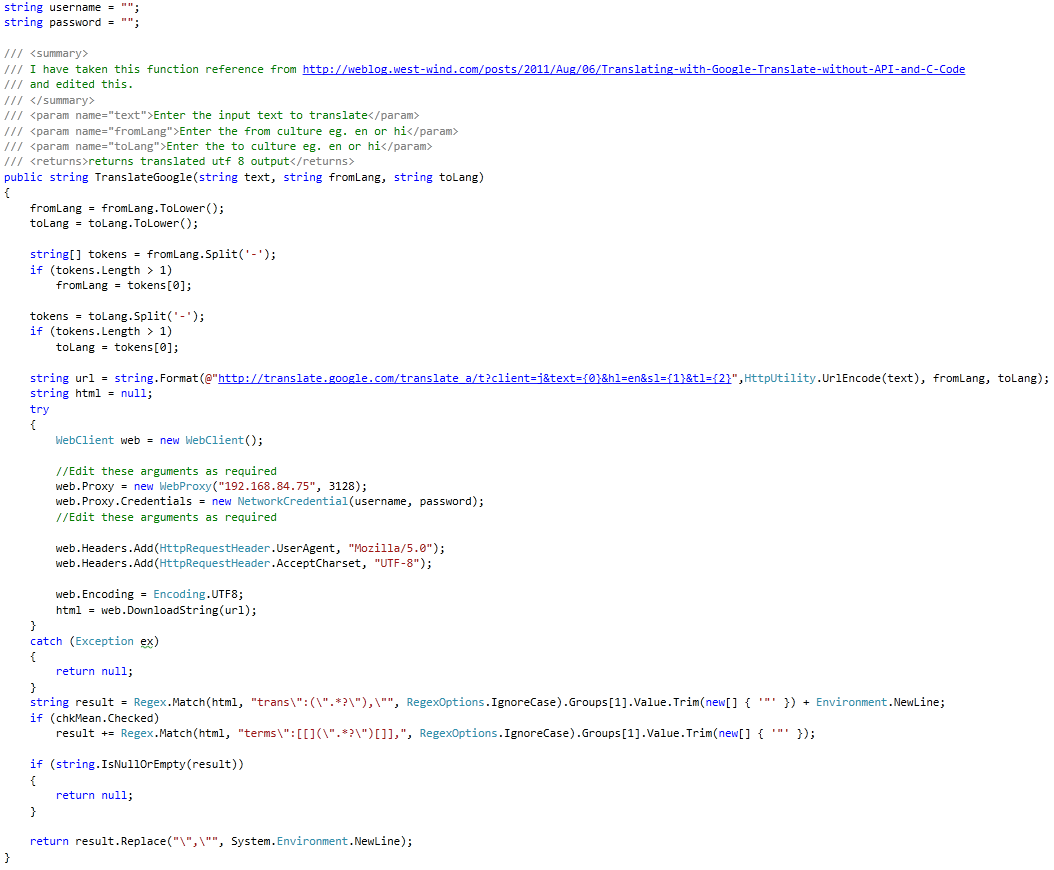
I am using http://translate.google.com/translate_a url.

Points of Interest

This code is edited by me and more features are added to make a handy translator. I hope this will help readers.

History

  • Version 1.0 - GoogleTranslateDesk

Download Source Code

Google Translator C#

Google Translator C#

What is it?

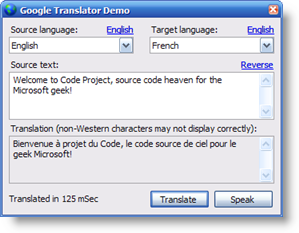
GoogleTranslator in actionGoogleTranslator is an object that allows you to translate text using the power of Google's online language tools. The demo app also allows you to easily perform a reverse translation. The app can be used as a poor man's resource translator for simple phrases, but you'd be wise to confirm the translation with a native speaker before using the results.

How do I use it?

You use GoogleTranslator by constructing it and calling its Translate() method.
 
    using RavSoft.GoogleTranslator;
    
    Translator t = new GoogleTranslator();
    string translation = t.Translate ("Hello, how are you?", "English", "French");
    Console.WriteLine (translation);
    Console.WriteLine ("Translated in " + t.TranslationTime.TotalMilliseconds + " mSec");
    Console.WriteLine ("Translated speech = " + t.TranslationSpeechUrl);

How it works

GoogleTranslator works by directly invoking Google's translation API called by its online translation form and parsing the results.
 
    // Initialize
    this.Error = null;
    this.TranslationSpeechUrl = null;
    this.TranslationTime = TimeSpan.Zero;
    DateTime tmStart = DateTime.Now;
    string translation = string.Empty;

    try {
        // Download translation
        string url = string.Format ("https://translate.googleapis.com/translate_a/single?client=gtx&sl={0}&tl={1}&dt=t&q={2}",
                                    Translator.LanguageEnumToIdentifier (sourceLanguage),
                                    Translator.LanguageEnumToIdentifier (targetLanguage),
                                    HttpUtility.UrlEncode (sourceText));
        string outputFile = Path.GetTempFileName();
        using (WebClient wc = new WebClient ()) {
            wc.Headers.Add ("user-agent", "Mozilla/5.0 (Windows NT 6.1) AppleWebKit/537.36 " +
                                          "(KHTML, like Gecko) Chrome/41.0.2228.0 Safari/537.36");
            wc.DownloadFile(url, outputFile);
        }

        // Get translated text
        if (File.Exists (outputFile)) {

            // Get phrase collection
            string text = File.ReadAllText(outputFile);
            int index = text.IndexOf (string.Format(",,\"{0}\"", Translator.LanguageEnumToIdentifier (sourceLanguage)));
            if (index == -1) {
                // Translation of single word
                int startQuote = text.IndexOf('\"');
                if (startQuote != -1) {
                    int endQuote = text.IndexOf('\"', startQuote + 1);
                    if (endQuote != -1) {
                        translation = text.Substring(startQuote + 1, endQuote - startQuote - 1);
                    }
                }
            }
            else {
                // Translation of phrase
                text = text.Substring(0, index);
                text = text.Replace("],[", ",");
                text = text.Replace("]", string.Empty);
                text = text.Replace("[", string.Empty);
                text = text.Replace("\",\"", "\"");
            }

            // Get translated phrases
            string[] phrases = text.Split (new[] { '\"' }, StringSplitOptions.RemoveEmptyEntries);
            for (int i=0; (i < phrases.Count()); i += 2) {
                string translatedPhrase = phrases[i];
                if (translatedPhrase.StartsWith(",,")) {
                    i--;
                    continue;
                }
                translation += translatedPhrase + "  ";
            }

            // Fix up translation
            translation = translation.Trim();
            translation = translation.Replace(" ?", "?");
            translation = translation.Replace(" !", "!");
            translation = translation.Replace(" ,", ",");
            translation = translation.Replace(" .", ".");
            translation = translation.Replace(" ;", ";");

            // And translation speech URL
            this.TranslationSpeechUrl = string.Format ("https://translate.googleapis.com/translate_tts?ie=UTF-8&q={0}&tl={1}&total=1&idx=0&textlen={2}&client=gtx",
                                                       HttpUtility.UrlEncode (translation),
                                                       Translator.LanguageEnumToIdentifier (targetLanguage),
                                                       translation.Length);
        }
    }
    catch (Exception ex) {
        this.Error = ex;
    }

    // Return result
    this.TranslationTime = DateTime.Now - tmStart;
    return translation;
As you can see, the logic used to parse the JSON result is very simple!

Speaking the translation

The Translator object retrieves the URL that will stream the spoken version of the translation. The demo app speaks this content by navigating to this URL in a hidden browser control. As mentioned in the preamble, because Google limits the speech to common words in a few languages, don't be surprised if the demo plays dumb when you try to speak your translated text!

Revision History

  • 18 Mar 2016
    Switched to Google Translate plugin APIs.  Fix identified by User-12366202.  Thank you!
  • 6 Aug 2015
    Corrected parsing logic.  Fix identified by Member 11019371.  Thank you!
  • 6 May 2015
    Corrected parsing logic to fix translation of single words.
  • 5 May 2015
    Corrected Google URL.
    Removed all external dependencies.
  • 9 Mar 2014
    Switched to using Google's JSON translation APIs.
    Added TranslationTime and TranslationSpeakUrl properties.
    Tweaked demo app UI to assist in reverse translation and resetting an English source and target.
  • 13 Jan 2013
    Added support for current full language set.
    Refixed bug that limited translation to first sentence.
    Fixed a bug that caused reverse translation to fail when accented characters were present.
  • 10 Mar 2010
    Added support for current full language set.
    Fixed bug that limited translation to first sentence.
  • 15 Feb 2010
    Even more parsing tweakage.
  • 28 Mar 2009
    More parsing tweakage.
  • 20 Mar 2007
    Tweaked parsing logic to conform to changes at Google's website.
  • 15 Jan 2006
    Initial version.

Download Source Code